 Mohamed Algarj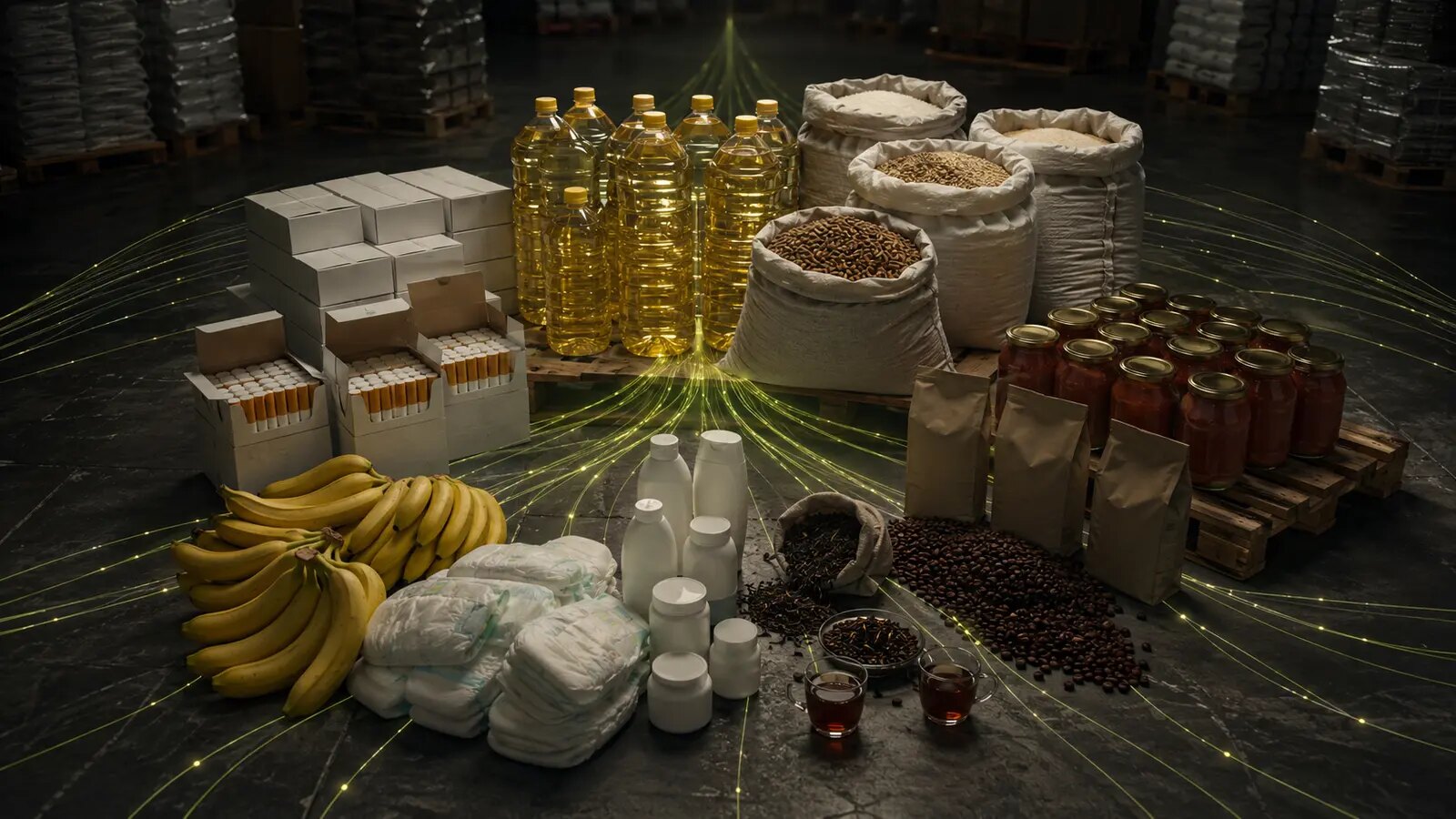
The first-four-months analysis grouped credits for cooking oil, sugar, barley and feed, tea, coffee, cigarettes, bananas, diapers, shampoo and ketchup. Its converted basket total exceeded one billion Libyan dinars.
The point was not that every item was unnecessary. The breadth of the basket showed how widely Libya depended on official foreign currency to finance everyday consumption.
formed the selected basket — food, household goods, tobacco and agricultural inputs.
A portrait of import dependence
The list spans necessities, production inputs and discretionary consumption. Some inputs support domestic output; some finished goods may be cheaper to import; others may reveal opportunities for local capacity.
The policy question is whether those differences are assessed before official dollars are allocated.
From a list to an industrial test
Each category should be examined against annual demand, concentration, local inputs, water and energy cost, employment potential and price stability.
The purpose is not forced self-sufficiency. It is to ask whether trade finance and industrial policy work together or finance the same dependency year after year.
Preserving the original scope
This article records the selected categories and conversion used in the original four-month publication. A later cumulative ledger or different commodity definition will naturally yield another figure.
The basket mixes four different economic roles
Cooking oil and sugar are household staples; barley and feed are production inputs; diapers and shampoo are household manufactured goods; cigarettes are a discretionary and taxed product. Combining them demonstrates dependence on official foreign exchange, but it does not establish a single policy priority.
A serious reading classifies each line as essential consumption, productive input, health or household good, or discretionary demand, then measures value, volume, concentration and local alternatives within the class.
The dinar conversion needs a stated rate
The claim that the basket exceeded one billion dinars depends on the exchange rate and whether the source values were all in dollars. Mixed-currency rows must first be converted to a common dollar basis at transaction-date or explicitly chosen rates, then converted to dinars once.
Without the complete retained worksheet, the responsible approach is to preserve the historical headline, label it as a retained aggregation and avoid inventing missing category subtotals. Future releases should include the calculation file alongside the article.
Import substitution should be selective
Local production is not automatically cheaper or more resilient. Water-intensive crops, small markets, unreliable power and imported packaging can erase the apparent saving. Conversely, processing, packing or manufacturing may create value even when raw materials remain imported.
Each category needs a feasibility screen: demand scale, domestic input share, capital, water and energy, jobs, quality, competitive price and foreign-exchange saving. That prevents “produce everything” from replacing analysis.
Turn the basket into a recurring scorecard
A quarterly scorecard should show financed and customs-cleared value and quantity by category, top beneficiary shares, bank concentration, origin, domestic output and retail-price movement. Overlapping cumulative periods must be clearly identified.
The scorecard would reveal whether the same dependence persists, shifts between products or responds to investment. It would also help distinguish a legitimate import requirement from a repeated failure to build viable capacity.
Archive note: The complete original worksheet is not currently available, so the English edition preserves the published headline and argument without inventing missing category totals.