 Mohamed Algarj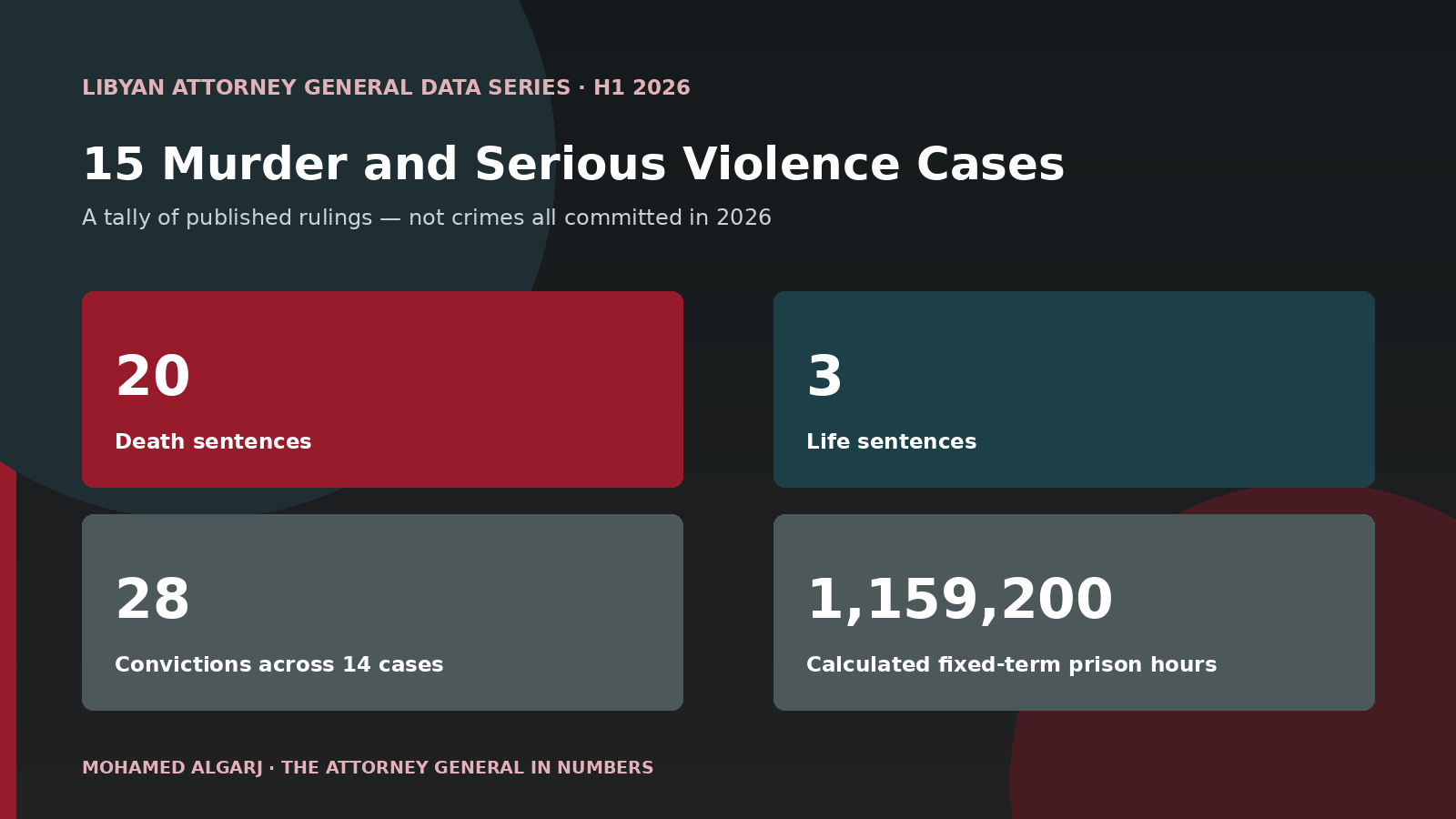
A comprehensive review of 16 posts published by the Libyan Attorney General’s Office during the first half of 2026 identified 15 distinct case tracks involving homicide and serious violence; two of the posts were updates on the same case.
In the 14 cases for which judicial outcomes were published, 28 people were convicted. The penalties included 20 death sentences, three life terms and determinate prison sentences totalling 132 years and four months. One defendant was explicitly reported acquitted.
These categories are not necessarily mutually exclusive. The same person may have received more than one penalty for different offences within a single case. They therefore cannot be added together to produce a new count of convicted people.
The fifteenth case remained at the stage of identifying suspects and issuing arrest warrants during the period under review.
More importantly, these figures account for rulings and posts published during the first half of the year—not crimes that all occurred in 2026. Most of the underlying offences date to earlier years, and some occurred more than a decade ago.
| Indicator | Published total |
|---|---|
| Attorney General’s Office posts | 16 |
| Distinct case tracks | 15 |
| Cases with published judicial outcomes | 14 |
| People convicted | 28 |
| Death sentences | 20 |
| Life sentences | 3 |
| Aggregate determinate prison terms | 132 years and 4 months |
| Explicit acquittals | 1 |
Dear reader, let us turn to the details—and place what the Attorney General’s Office disclosed within the wider international picture of homicide, violence and the performance of justice. #LibyanAttorneyGeneralByTheNumbers
20 Death Sentences Across 11 Cases
The death sentences were distributed as follows: four in the case concerning the killing of Ibrahim Faraj Abdeljawad in Sabha; three in the abduction and killing of a woman in Zawiya; three in the killing of three members of the al-Qahf family in Bani Walid; two in the Abdelnasser al-Hamali case; and two in the case concerning the killing of four people in Zawiya in 2017.
The remaining six were imposed one apiece in the cases involving Abdelrahman Milad, Mohamed Abubakr Ibrahim, Ali Abu Ajila Qari, Ibrahim Zuwaita and Ali Bazina, the Gharghour protesters, and Abdelhafiz Belhaj.
For numerical context only, Amnesty International ↗ recorded at least 13 death sentences in Libya during 2025: nine for murder, three for rape and murder, and one in a drug-related case. It did not confirm any executions. Amnesty also stated that its figure covered only cases it was able to document in western Libya, under the Government of National Unity, and that the actual total may have been higher.
The 20 sentences visible in the Attorney General’s Office posts for the first half of 2026 are therefore seven—or about 54%—above Amnesty’s documented minimum for all of 2025. This is not, however, a like-for-like comparison over time or between sources: the monitoring periods, case coverage and documentation methods differ.
A death sentence also does not mean that the judgment is final or that it has been carried out. The prosecution’s posts did not systematically disclose the appeal stage or final legal status of each sentence.
More Than One Million Hours in Determinate Prison Sentences
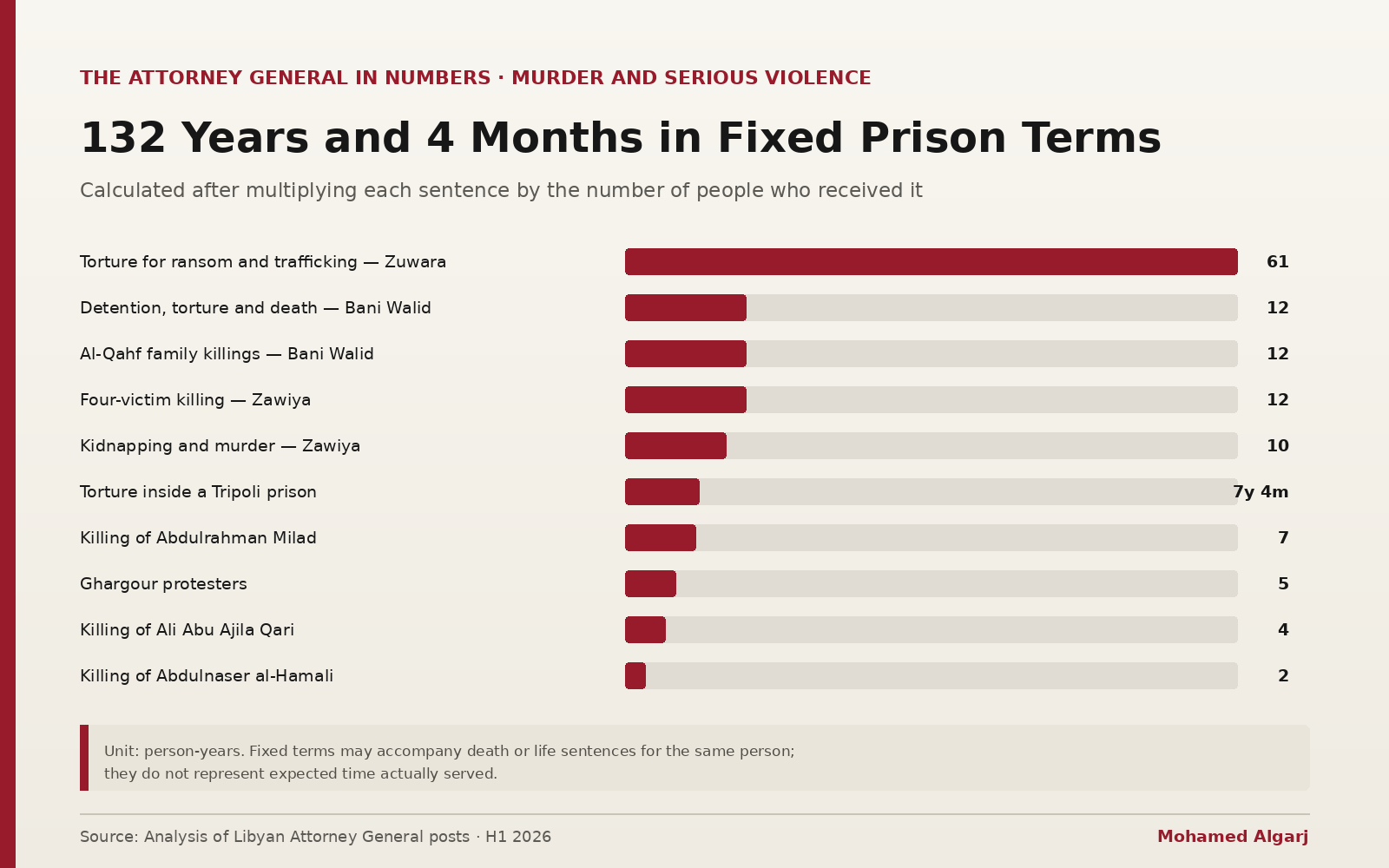
The determinate prison sentences totalled 132 years and four months. Using 365 days per year and 30 days per month, that equals a calculated aggregate of 48,300 days, or 1,159,200 hours.
This is a nominal total of the determinate terms stated in the judgments, calculated by multiplying each term by the number of people who received it. Death and life sentences were not converted into units of time. A determinate term may also have been imposed on someone who received a death or life sentence for a separate offence, while the posts do not indicate whether multiple terms are to run concurrently or consecutively. The figure should therefore not be read as the amount of prison time that will actually be served.
 Enlarge figure ↗
The torture-for-ransom and trafficking case in Zuwara accounted for 61 years. It was followed by 12 years in the Bani Walid unlawful detention, torture and death case; 12 years in the al-Qahf family case; and 12 years in the case involving four victims in Zawiya.
The published penalties also included ten years for a juvenile defendant in the abduction and murder case; seven years in the Abdelrahman Milad case; seven years and four months in a case involving torture inside a Tripoli prison; five years in the Gharghour case; four years in the Ali Abu Ajila case; and two years in the al-Hamali case.
In the Bani Walid case, the acts were attributed to 14 people, but the post reported that only two had been arrested and subsequently convicted. The prosecution did not publish information showing whether the other 12 had been arrested or referred to trial.
Rulings Published in 2026 for Crimes Dating Back to 2013
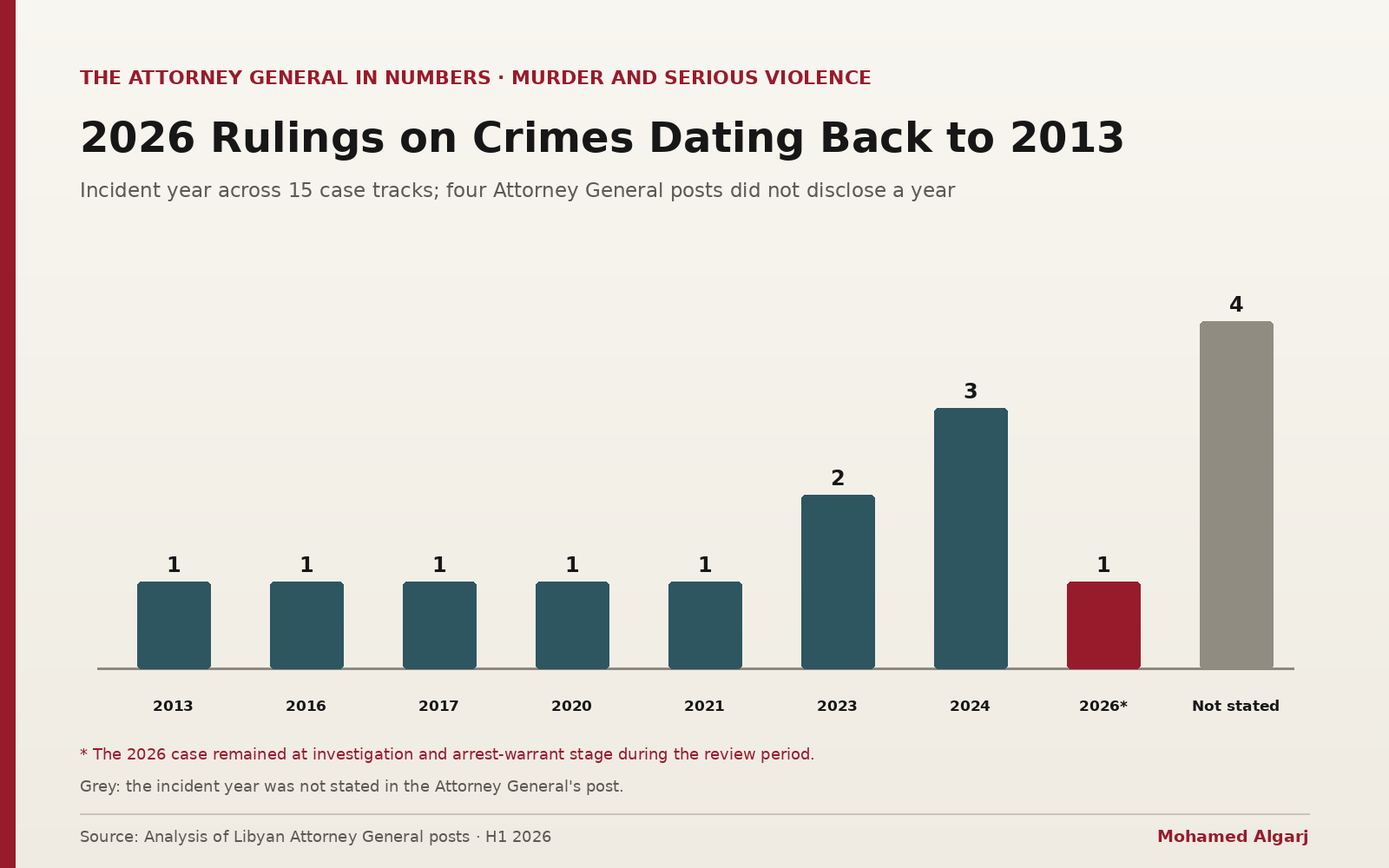
Of the 14 cases with published judicial outcomes, ten—71.4%—disclosed the year in which the crime occurred. Every disclosed year preceded 2026: one case dated to 2013, one to 2016, one to 2017, one to 2020, one to 2021, two to 2023 and three to 2024. The year of the offence was not published in the remaining four cases.
Even among the 11 cases involving death sentences, all nine incidents whose dates were disclosed occurred before 2026; two had no published date.
The fifteenth case—the only unresolved case in this file—was also the only one that the Attorney General’s Office explicitly said occurred in 2026. It concerns the killing of Saif al-Islam Gaddafi. The office announced that three suspects had been identified and arrest warrants issued, but nothing published during the review period confirmed their arrest, pretrial detention, referral to trial or conviction.
 Enlarge figure ↗
No Recorded Libya Rate in the UNODC Series; WHO’s Model Points to About 150 Deaths in 2021
The World Bank series based on UNODC data ↗ displays no national value for Libya’s intentional homicide rate. This does not mean the rate is zero, or that no domestic data exist. It means that this particular international database does not present a recorded national figure that can be compared with other countries.
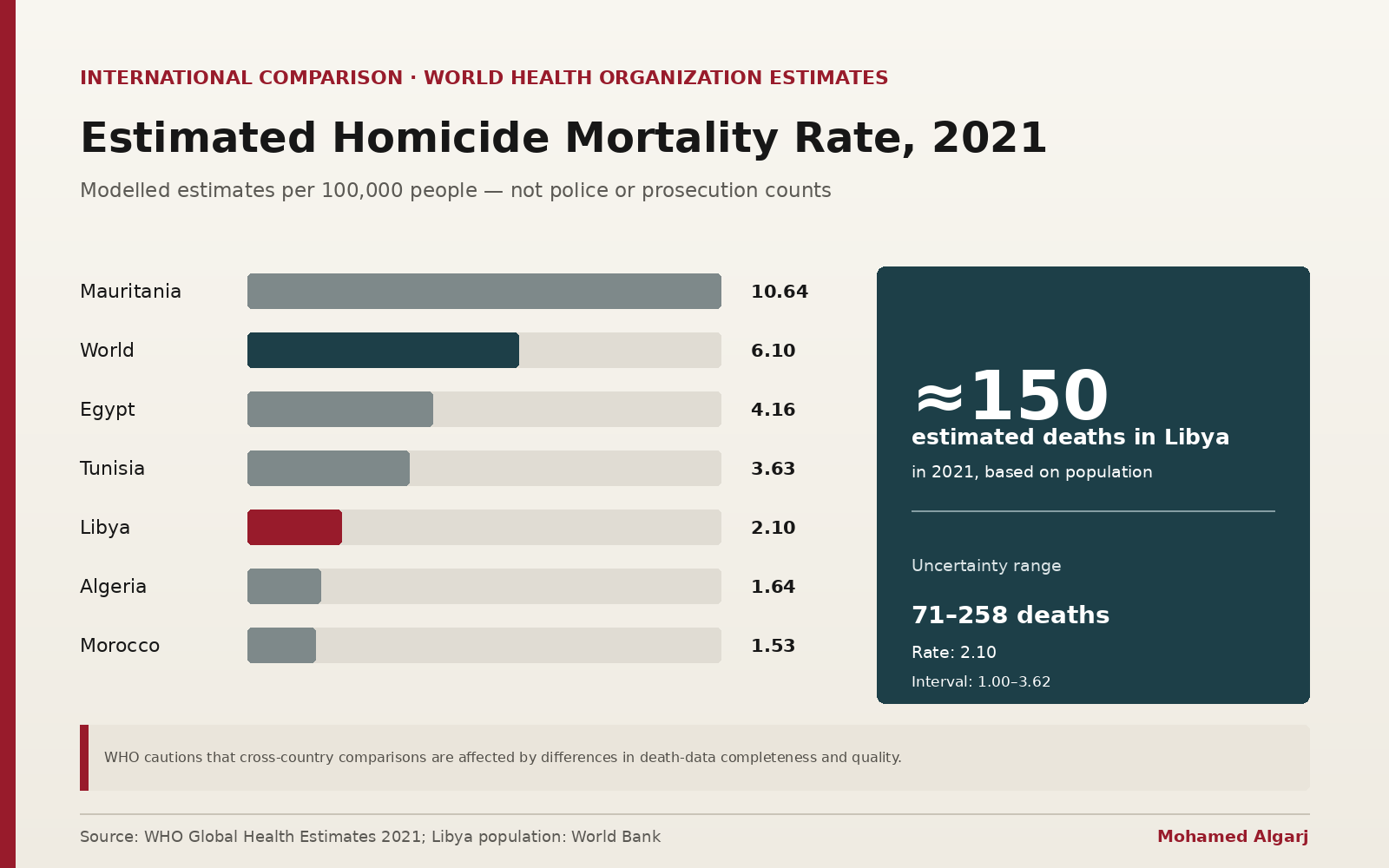
By contrast, the World Health Organization ↗, in its official data file ↗, gives Libya a modelled estimate of 2.10 homicide deaths per 100,000 people in 2021, with an uncertainty range of 1.00 to 3.62. The estimate was 3.30 for males and 0.85 for females.
Using Libya’s 2021 population of 7,135,175, as reported by the World Bank ↗, the central rate translates mathematically into about 150 deaths that year, with a range of roughly 71 to 258. This is not a count recorded by the police or prosecution; it is a calculation based on the WHO model.
Using the same dataset and reference year, the modelled rate was 1.53 in Morocco, 1.64 in Algeria, 2.10 in Libya, 3.63 in Tunisia, 4.16 in Egypt and 10.64 in Mauritania, compared with a global estimate of 6.10 per 100,000 people.
Libya’s central estimate was therefore about 37% higher than Morocco’s and 28% higher than Algeria’s, but roughly 42% lower than Tunisia’s, 50% lower than Egypt’s and 66% below the global average. These differences should not be treated as a definitive ranking, given the wide uncertainty ranges and weaknesses in death-registration data.
 Enlarge figure ↗
Using a different estimation method, the UNODC Global Study on Homicide ↗ estimated that about 458,000 people were victims of intentional homicide worldwide in 2021—roughly 52 every hour. Men and boys accounted for 81% of them.
18 Numerically Specified Deaths—and the Actual Total Was Higher
It was possible to identify 18 deaths numerically across the cases reviewed, in addition to an unspecified number of people killed in the Gharghour case. The files involving Zuwara, the Tripoli prison and Bani Walid also referred to victims of violence or torture whose number was not disclosed; not all were necessarily fatalities.
The 18 deaths cannot be compared with the WHO estimate. The prosecution posts concern cases arising between 2013 and 2026 and do not constitute an annual national register of all homicides.
| Source | Period | What it measures | Figure |
|---|---|---|---|
| Attorney General’s Office posts | Incidents from 2013–2026, published in H1 2026 | Numerically specified deaths across 15 case tracks | 18, plus an unspecified number of additional deaths |
| World Health Organization | 2021 | Modelled estimate of homicide deaths in Libya | About 150, within a range of 71–258 |
| United Nations Support Mission in Libya | March 2024–October 2025 | Deaths in custody across Libya | At least 23 |
| UNSMIL and the Libyan Mine Action Centre | May 2020–May 2026 | Casualties from explosive ordnance | 487 casualties: 175 deaths and 312 injuries, including 87 children |
A report by the UN Secretary-General ↗ documented at least 23 deaths in custody across Libya between March 2024 and October 2025.
In the latest update published by UNSMIL in May 2026 ↗, explosive-ordnance incidents in Libya since May 2020 had caused 487 casualties: 175 deaths and 312 injuries. Children accounted for 87 of the total casualties.
These figures must not be added together because their periods and definitions differ. They nevertheless expose the need for a unified national register that distinguishes intentional homicide, deaths in custody, and casualties from armed clashes and explosive ordnance.
Libya Ranks Last in Africa on the Judicial Process Indicator
According to the 2024 Ibrahim Index of African Governance ↗, whose latest data measure performance in 2023, Libya scored 33 out of 100 in Security and Rule of Law, ranking 46th among 54 African countries.
It scored 25.2 in Rule of Law and Justice, ranking 49th, and just 6.4 in Judicial Process—placing last in Africa.
These indicators do not measure the homicide rate. They do, however, show why the severity of punishment alone cannot establish that justice is effective. The broader test also includes the speed of investigations, execution of arrest warrants, protection of appeal rights and victims, and publication of final case outcomes.
The Economics of Violence: Crimes With No Published Price Tag
Across the 15 cases, the published material gave no specified value for fines, compensation or reparations to victims’ families. Three cases referred to the destruction of movable property without estimating its value. In the Sabha case, the court also ordered publication of the judgment at the convicted people’s expense, without disclosing the cost.
According to the Institute for Economics and Peace’s Global Peace Index 2026 ↗, the global economic impact of violence in 2025 reached approximately $21.8 trillion in constant 2025 purchasing-power-parity dollars—equivalent to 10.5% of global GDP. Homicide accounted for 5.3% of that impact, which the report valued at about $1.16 trillion.
This global figure cannot be extrapolated to Libya. It does, however, show that the absence of a national estimate for the costs of homicide, violence, compensation and reparations is a financial and institutional gap—not merely a missing detail.
Mohamed Algarj
Accountability Questions
- Where is Libya’s annual national homicide register, disaggregated by year of offence, city, sex, age and the relationship between perpetrator and victim? Why does Libya remain absent from the international UNODC series?
- What is the current legal status of the 20 death sentences and three life terms? How many are final? What happened to the 12 people implicated in the Bani Walid case whose arrests were not reported, and to the three suspects in the Saif al-Islam Gaddafi case?
- Why are judgments not published alongside complete data on victims, compensation, property damage, and the costs of investigation and trial? Who is responsible for reconciling figures held by the prosecution, police, health authorities, prisons and the United Nations mission?
Sources: Libyan Attorney General’s Office; World Health Organization; World Bank and UNODC; United Nations Support Mission in Libya; Ibrahim Index of African Governance; Institute for Economics and Peace; Amnesty International.
Methodology: This analysis is based on a comprehensive review of posts published by the Libyan Attorney General’s Office during the first half of 2026. Posts concerning the same case were consolidated into a single case track. The thematic categories overlap: the same case may also appear in another file, but it was counted only once within this one. Totals from separate files therefore cannot be combined into an overall figure without first removing duplicates. The latest available years were used for international indicators, while recorded figures were kept separate from modelled estimates and data from different periods or categories of violence were not combined.