 Mohamed Algarj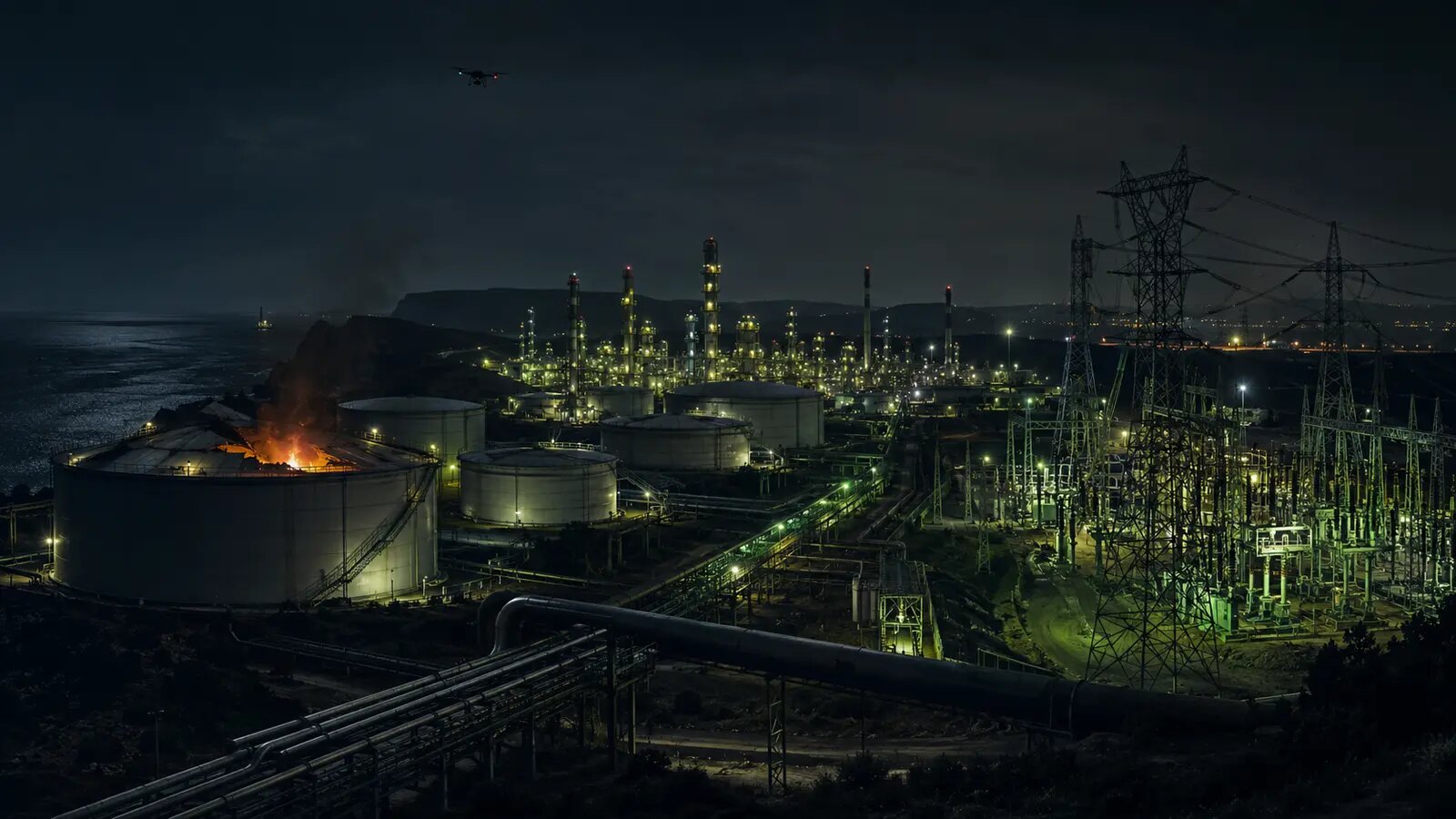
The first images from Zawiya showed fire. The more important story was the system around it: fuel distribution, crude supply, electricity generation and the confidence of the people expected to keep all three operating.
In August 2026, a series of reported drone attacks struck energy infrastructure around Zawiya. The National Oil Corporation said a gasoline tank holding 4.5 million litres collapsed after a fire at the oil depot. The refinery itself was reported unharmed, but fuel distribution was disrupted and the corporation warned that continued attacks could force it to declare force majeure.
Days later, Libya’s state power company said an attack on the Zawiya substation caused a major outage. More than 700 megawatts of the 1,300-megawatt capacity associated with the Zawiya power complex became unavailable. General Electric withdrew technical teams, underlining a second-order effect that is easy to miss: insecurity removes expertise as well as equipment.
A national chain of dependence
Zawiya’s refinery has a capacity of about 120,000 barrels per day and is linked by pipeline to the Sharara field, whose capacity is around 300,000 barrels per day. The site sits inside a wider chain connecting production in the south, processing and storage on the coast, domestic fuel supply, exports and power generation.
Damage at one point in that chain moves quickly. A depot fire constrains fuel distribution. A power failure affects pumping, processing and public services. The threat of repeated strikes changes staffing decisions, insurance costs and maintenance schedules. Even when physical damage is repaired, the risk premium remains.
This is why the event should not be framed as a local incident in western Libya. It is a national economic security problem. Libya’s public finances depend overwhelmingly on hydrocarbons, while households and businesses depend on electricity and subsidised fuel. Zawiya connects those two forms of dependence.
of the reported 1,300-megawatt capacity was unavailable after the substation attack — more than 700 megawatts.
Accountability without speculation
No group had publicly claimed responsibility in the immediate reporting. That fact matters. Responsible analysis should not convert uncertainty into accusation. The state’s first duty is to preserve evidence, publish a technical account of the damage and establish a credible investigation that can separate verified findings from political narratives.
The National Oil Corporation, electricity company and relevant security bodies should issue a joint incident record: time and location of each strike, infrastructure affected, downtime, lost output or distribution capacity, repair cost, safety impact and the status of any investigation. Different institutions currently describe different pieces of the event. A national risk picture requires one reconciled account.
Critical facilities also need protection designed around continuity, not only perimeter control. Redundant power connections, dispersed firefighting capacity, protected control systems, rapid-repair contracts and pre-agreed fuel-distribution alternatives can reduce the economic effect of an attack even when prevention fails.
The cost after the fire
Force majeure is a legal and commercial signal, but the deeper cost arrives before it is declared. Buyers question reliability, contractors reassess exposure, technical teams leave and planned maintenance becomes harder. Domestic markets then absorb the disruption through shortages, queues, outages or additional import requirements.
Libya cannot remove every security risk from its energy system. It can reduce the system’s fragility and make the cost of disruption visible. That begins by treating attacks on refineries, depots and substations as one economic-security file, with public reporting, technical accountability and continuity planning across institutions.
The fire at Zawiya was extinguished. The vulnerability it revealed was not.