 Mohamed Algarj
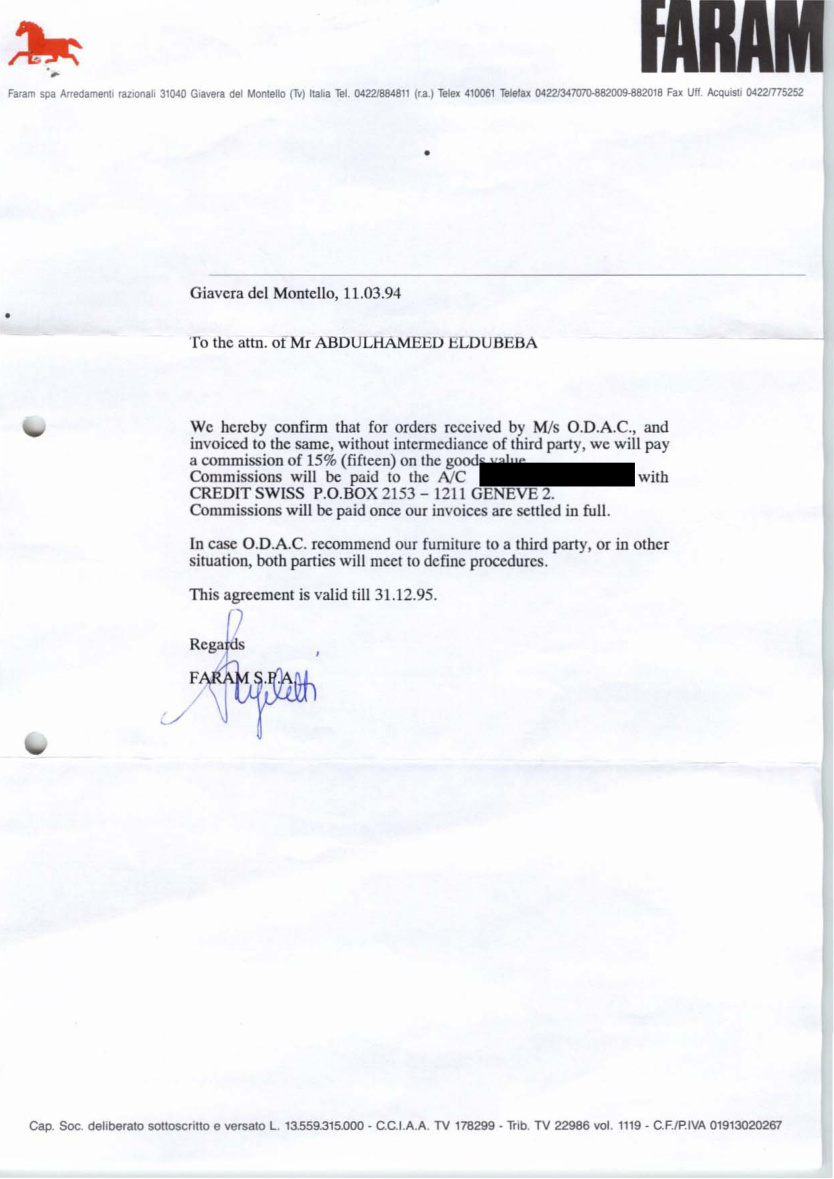
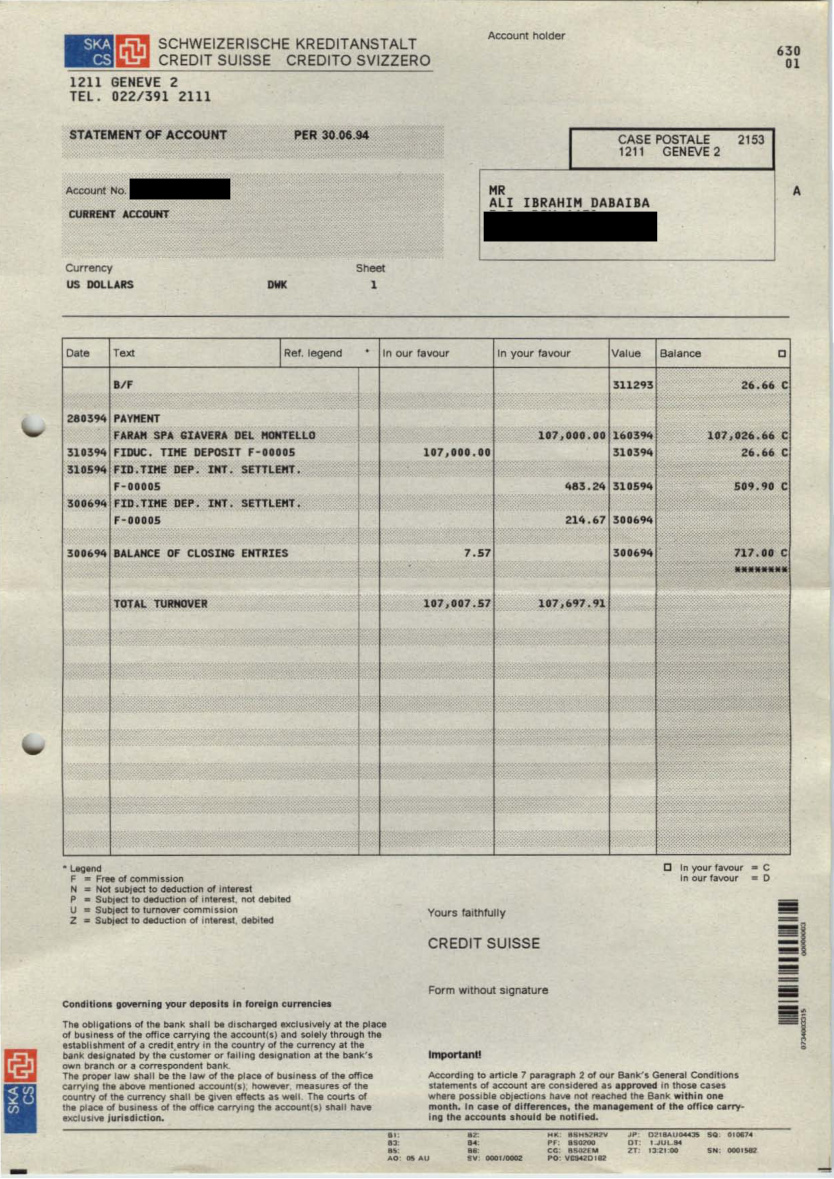
On 11 March 1994, the Italian furniture supplier Faram addressed a letter to “ABDULHAMEED ELDUBEBA,” promising a 15% commission on goods purchased by Libya’s Organization for Development of Administrative Centers, known as ODAC. The letter specified an account at Credit Suisse in Geneva for payment. A bank statement in the same document collection bears the identical account number under a different name: “ALI IBRAHIM DABAIBA.” It records an incoming payment of US$107,000 from Faram. Exhibit 1 ↗
The roles matter. ODAC was the public body buying for government projects; Faram supplied furniture and fittings. A commission is a fee paid by a supplier for agency or other services. Such a payment is not, by itself, evidence of corruption. The accountability question is whether its beneficiary had a connection to the public purchasing decision, and whether that connection was disclosed and authorized.
The matching account number provides a concrete starting point in a collection spanning a supplier in Italy, public projects in Libya, correspondence with companies in Cyprus, agency arrangements involving Transinfo, and accounts in Switzerland. Why would a supplier address a commission agreement to one person and designate an account bearing another person’s name? What service earned the fee, and who within the public purchasing body knew about the arrangement?
 Enlarge figure ↗
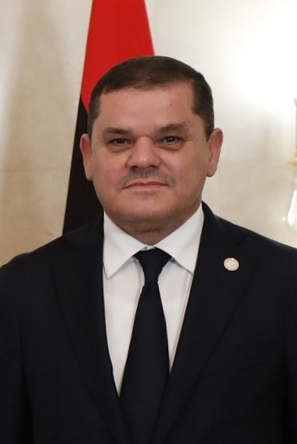
Abdul Hamid Dbeibeh, 15 April 2021. Photograph: Government.ru, via Wikimedia Commons ↗, under CC BY 4.0 ↗. This is the crop published by the source. Earlier reporting identified the addressee of the 1994 letter as Abdulhamid Dbeibah; the accompanying bank statement is in Ali Ibrahim Dabaiba’s name.
This investigation examines ten files containing 94 pages, including repeated copies of some documents. The principal events run from 1994 to early 2000. The circulating copies have not been independently authenticated with their purported issuers for this investigation. Parts of the story, including the letter and the US$107,000 entry, were reported in March 2021 by Tabadul, citing The Investigative Journal. The contribution of this examination is to read the papers together, reconcile their figures and distinguish what the documents support from what has been claimed—including a correction to a substantial sum previously characterized as commissions. Earlier reporting ↗
The March 1994 letter applies the commission to orders invoiced by Faram directly to ODAC, without a third-party intermediary. Payment was due after the supplier’s invoices had been settled in full, and the arrangement ran until 31 December 1995. Three days after the letter was written, Faram sent a covering letter to a Credit Suisse employee, enclosing an agreement relating to the same named addressee. That places the bank in the correspondence about the agreement. It does not establish, on its own, what checks the bank conducted or who reviewed the material. Exhibit 1, pages 1 and 3 ↗
 Enlarge figure ↗
The statement, drawn up as of 30 June 1994, shows the US$107,000 credit from Faram with a booking date of 28 March and a value date of 16 March. A subsequent entry moves the same amount into a time deposit. It is not a second commission. Crucially, this document does not show Abdulhamid receiving the money in a personal account: the account holder named on it is Ali Ibrahim. Nor does this collection contain the underlying invoice needed to establish that the payment represented exactly 15% of a particular contract. Exhibit 1, page 2 ↗
 Enlarge figure ↗
 Enlarge figure ↗
Ali Ibrahim Dabaiba, who chaired ODAC from 1989 to 2011, according to OCCRP’s 2022 investigation ↗. Photograph attributed by OCCRP to his Facebook account.
The appearance of the purchasing body’s chairman’s name on the account specified in the supplier’s commission letter gives the matter its public significance. If the documents and identities are authenticated, the relationship between public office and private benefit requires an explanation regardless of the eventual total. Establishing it would require the original agreement, account ownership and beneficial-ownership records, the contract behind the payment, and any disclosure or authorization within ODAC.
In August 1995, another step appears in the correspondence. Faram wrote to Ahmed Lamlum at Fabulon in Cyprus, requesting a written, signed release from earlier obligations to “A. DUBAIBA” before entering a new agreement. The initial alone does not identify the individual. It does show that the later agency arrangement was accompanied by a request to settle a pre-existing obligation bearing the family name. Exhibit 2, page 2 ↗
Transinfo is the company assigned the agency role and associated fees in these papers. Fabulon appears in correspondence addressed to Lamlum in Cyprus. Lamlum connects the supplier with those administering the financial arrangements: he signs the agency agreement and sends instructions concerning money and invoices. The appearance of two companies and an individual in the correspondence is not, by itself, proof of who ultimately owned or controlled the companies.
An agency and consultancy agreement bears the signature of Faram president Umberto Bacilieri dated 4 September 1995 and Lamlum’s signature as managing director dated 7 September. It appoints Transinfo as exclusive agent in Libya and sets a general rate of 20% of ex-factory value, with project-specific rates including 18% for the Congress Hall. The services cover market and competitor information, pricing, and assistance in obtaining contracts. These are services that could be genuine. The investigative questions are who actually performed them, who benefited from the company, and how those people related to the public purchasing decision. Exhibit 3 ↗
In a letter dated 12 September 1995, Lamlum sent Sedes Treuhand Anstalt instructions concerning several different amounts. First, he referred to consultancy fees for “Mr A. Dabaiba,” without specifying a value, and requested that they be credited to his account pending resolution of Transinfo’s share. He then referred to another US$418,500, which he said had already been credited to the company’s dollar account for services to Faram, with an invoice to follow. A separate paragraph mentioned approximately DM15.78 million expected to be credited to ODAC’s account as an advance for a packaging plant. Exhibit 2, page 1 ↗
Keeping those three passages separate prevents a serious misreading. The letter does not assign the US$418,500 to Ali’s personal account, and it does not describe the German-mark sum as a commission. An invoice dated 17 August 1995 carries the same dollar amount and describes interior design, decoration and site-management services for the Sirte Administrative Building Complex, Phase II. The matching value connects the invoice with the correspondence; it does not establish delivery of the services or independently verify the receiving account. The September reference to an invoice “to follow” also needs explanation alongside the earlier invoice date. Exhibit 8 ↗
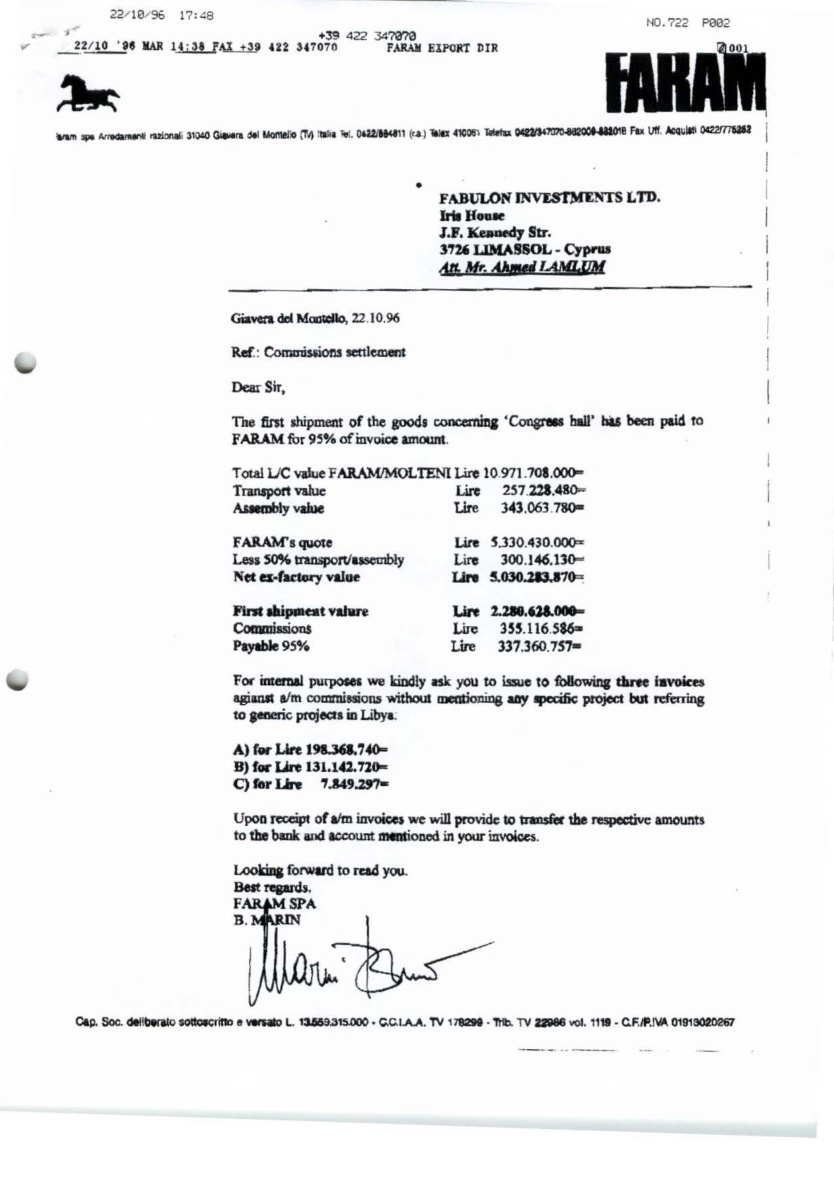
About a year later, the papers provide more specific evidence of how invoices were to be worded. On 22 October 1996, Faram asked Lamlum for three invoices for internal purposes, instructing him not to identify a specific project and instead to refer generally to projects in Libya. The requested amounts were ITL198,368,740, ITL131,142,720 and ITL7,849,297. Invoices 1224, 1225 and 1226, dated 18 December, carry those same amounts and use a generic project description. Exhibit 4 ↗
Together, the invoices total ITL337,360,757. The evidential point extends beyond that number: the instructions predate the invoices, and the invoices match both their amounts and the avoidance of a specific project name. This shows that a generic description was requested in the correspondence. It does not, by itself, establish a criminal purpose. Its practical accounting consequence is nevertheless clear. Someone reviewing the invoice alone would not know which public project generated the fee; the accompanying correspondence would be needed to reconstruct that link.
 Enlarge figure ↗
Letter dated 22 October 1996. Read the letter and the three matching invoices ↗.
Another letter, dated 15 December 1998, illustrates the commission calculation on an ODAC-related order. It gives the letter of credit’s value as ITL475,873,200. Deducting transport and installation leaves goods worth ITL379,125,200. The supplier requests a 20% commission invoice for approximately ITL75,825,000, and a subsequent invoice carries the requested amount. A documentary letter of credit is a banking mechanism for settling payment when specified documents and conditions are met. Its existence does not establish that the purchase price was fair or that a commission beneficiary was independent of the buyer. Here, the papers connect a specified credit, a calculation and an invoice request; they are not a bank statement proving receipt of that invoice’s value. Exhibit 7 ↗
The figures that follow are in Italian lire, the currency used in these historical invoices—not Libyan dinars or US dollars. Amounts in different currencies cannot be combined into a meaningful total without an explicit, dated conversion basis.
That distinction is particularly important for a much larger figure. The summary table at the end of the collection shows ITL5,237,580,492 in its first value column. But its rows use different bases: some contain goods values and others commission values. It cannot properly be described as a uniform total of commissions. Adding the column specifically designated for Transinfo commissions produces ITL1,577,778,495.20. The column marked as paid totals ITL1,028,961,770. Exhibit 6 ↗
| Column in the source table | Amount in Italian lire | What the figure supports |
|---|---|---|
| Mixed first value column | 5,237,580,492 | Not a consistent aggregate of commissions |
| Transinfo commission column | 1,577,778,495.20 | Sum of the amounts entered in that column |
| Paid column | 1,028,961,770 | Payments as recorded in the table, not all independently verified by bank statements |
The arithmetic difference between the last two columns is approximately ITL548.8 million. The table has no explicit closing date, however, and the collection includes later settlements and correspondence. That difference therefore cannot be declared a final debt outstanding on a particular date. Nor can every invoice and letter be added to a new grand total. Several documents describe the same obligation at different stages, from invoice request to issue and settlement.
For example, on 5 November 1998, Faram confirmed that it had transferred two remaining invoice balances, totaling ITL192,636,487, on 27 October through an Italian bank to Credit Suisse in Geneva. This is a supplier’s confirmation of a transfer, which carries more evidential weight than a promise to pay. It remains distinct from an independent bank record. The same letter mentions US$5,910 in accommodation expenses; that amount should not be treated as a commission simply because it appears beside commission-related payments. Exhibit 5 ↗
The international dimension is present in the documents themselves: public procurement in Libya, a supplier in Italy, commercial correspondence through Cyprus, and accounts in Switzerland. Establishing that cross-border chain does not require attaching every company or asset associated with the people concerned to the same money trail. Each institution holds part of the record. The Libyan buyer knows the project and price; the supplier knows the agent and fee terms; company administrators know the ownership arrangements; and the bank has the account transactions. Bringing those records together is the way to determine whether the payments purchased independent services or conferred a benefit connected to contract-awarding power.
In a separate development concerning Ali Dabaiba’s banking relationships, Swiss public broadcaster SRF reported on 26 September 2024 that it had examined a Federal Department of Finance penalty order relating to delayed reporting by Credit Suisse. According to SRF, the department considered that the bank should have reported its suspicions following checks in 2012, but did so only in 2018. A responsible employee was fined CHF2,000. This concerns banking reporting duties as described in that investigation. It is not a ruling authenticating the Faram papers, a conviction of Abdulhamid, or proof that every payment had a criminal source. SRF’s report ↗
In its response to the 2022 Suisse Secrets investigation, Credit Suisse rejected allegations and inferences about its business practices and said it had complied with the laws applicable at the relevant times. OCCRP also reported that a lawyer representing Ahmed Lamlum’s family denied his involvement in corrupt dealings and maintained that his business activities were lawful. Those are historical responses to another investigation. No new responses from the individuals or companies concerned were obtained for this review. OCCRP ↗
The outstanding questions are specific. Abdulhamid Dbeibah or his representative can clarify the letter, the addressee’s identity and his role in 1994. Ali Ibrahim or his representative can explain the account’s connection to the agreement and the payment’s purpose. Faram’s and Transinfo’s records can establish the services, ownership and beneficiaries, and why the invoices were requested without project names. ODAC and the oversight authorities can produce the original contracts, price comparisons, acceptance records and any disclosure or authorization of the commission arrangements.
The available papers support those questions with names, dates and amounts that can be compared. They do not establish that all services were fictitious, provide a definitive total of illicit proceeds, or automatically connect transactions from the 1990s with later government spending. Those limits also identify the missing records that could turn the tracing of commission arrangements into findings about specific responsibilities.
For Libyan readers, the central question is who benefited from state purchases and who knew. Internationally, it is what the companies and banks arranging the contracts, invoices and accounts understood about those benefits. Answering begins with a commission letter, a matching account number, a traceable payment and written instructions to omit a project’s name from the invoice.
The exhibits linked throughout this investigation are selected pages from the supplied files. Account numbers and irrelevant personal addresses have been redacted from the public copies; the originals have been retained unchanged for review. Page references in the exhibit index refer to PDF order, which may differ from numbers printed on the documents.
Analysis and writing: Mohamed Algarj.
Document source: political activist Hussam Elgomati. Source attribution does not constitute independent authentication of the documents.
Read the documents
Eight exhibits contain 16 selected source pages. Open each file to examine the records behind the reporting.
A 15% letter and a statement in Ali Ibrahim’s name recording US$107,000; not proof of personal receipt by Abdulhamid.
PDF · 3 pagesLocation in the source files
Faram Italy ODAC AID(1).pdf
Source pages: 1, 2, 3
Separates earlier obligations, unspecified fees, US$418,500 and an expected German-mark advance.
PDF · 2 pagesLocation in the source files
Faram ODAC Transinfo AL AID(1)(1).pdf
Source pages: 1, 2
Sets out Transinfo’s agency role, services and fee rates.
PDF · 2 pagesLocation in the source files
Faram ODAC AID AL Fabulon Commissions(1)(1).pdf
Source pages: 33, 34
The request and invoices match in their amounts and generic project descriptions.
PDF · 4 pagesLocation in the source files
Faram ODAC AID AL Fabulon Commissions(1)(1).pdf
Source pages: 11, 52, 51, 50
A supplier’s transfer confirmation, not a bank-issued statement.
PDF · 1 pageLocation in the source files
Faram Commissions transfered to Transinfo CSG(1)(1).pdf
Source pages: 1
Separates the commission column from the mixed first value column.
PDF · 1 pageLocation in the source files
Faram list of projects and payment to Transinfo(1)(1).pdf
Source pages: 1
Connects a specified credit, goods value and a 20% commission request.
PDF · 2 pagesLocation in the source files
Faram ODAC AID AL Fabulon Commissions(1)(1).pdf
Source pages: 53, 42
Describes services for the Sirte administrative complex; does not independently establish delivery.
PDF · 1 pageLocation in the source files
Faram ODAC AID AL Fabulon Commissions(1)(1).pdf
Source pages: 58