 Mohamed Algarj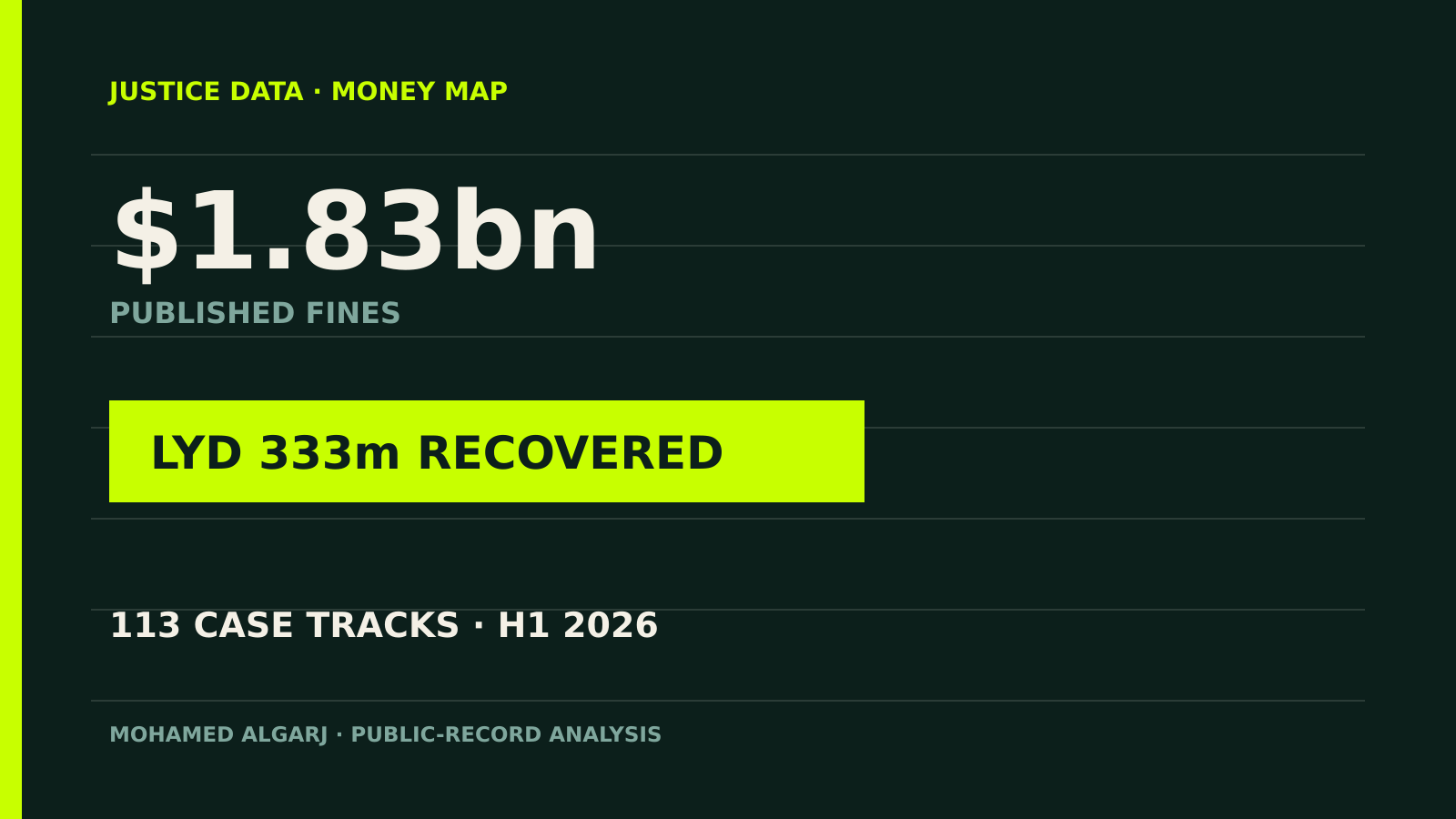
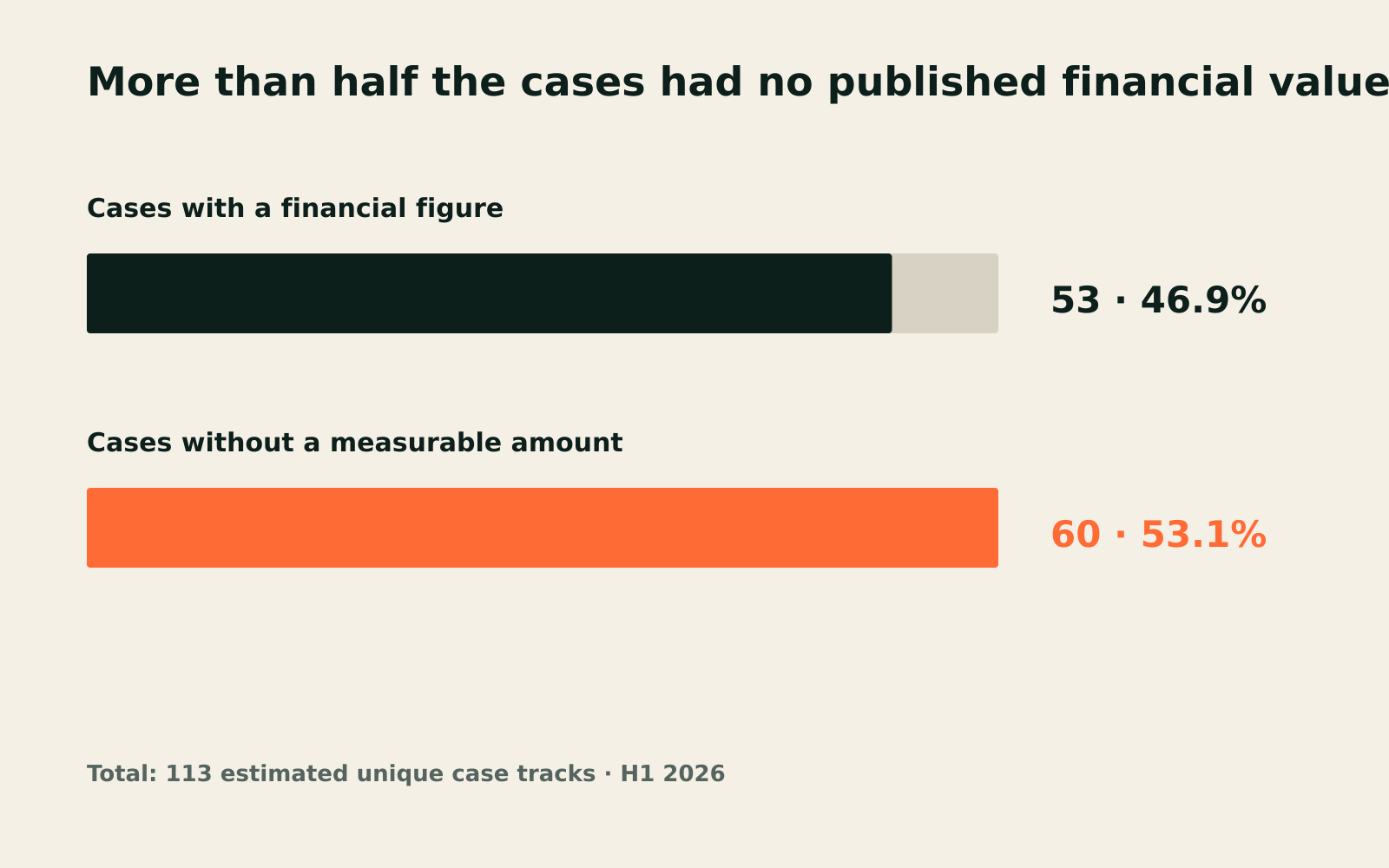
A review of Libyan Attorney General’s Office publications from the first half of 2026 identified an estimated 113 distinct case tracks. Only 53—46.9%—contained a financial figure that could be measured. The remaining 60 contained no usable amount.
The underlying ledger recorded 84 financial entries. After removing repeated appearances of the same cases across thematic files, 77 unique entries remained: four reports of money actually recovered, eight judicial restitution orders, 17 fines and 48 other amounts covering alleged embezzlement, waste, loans, contracts, bribes and benefits.
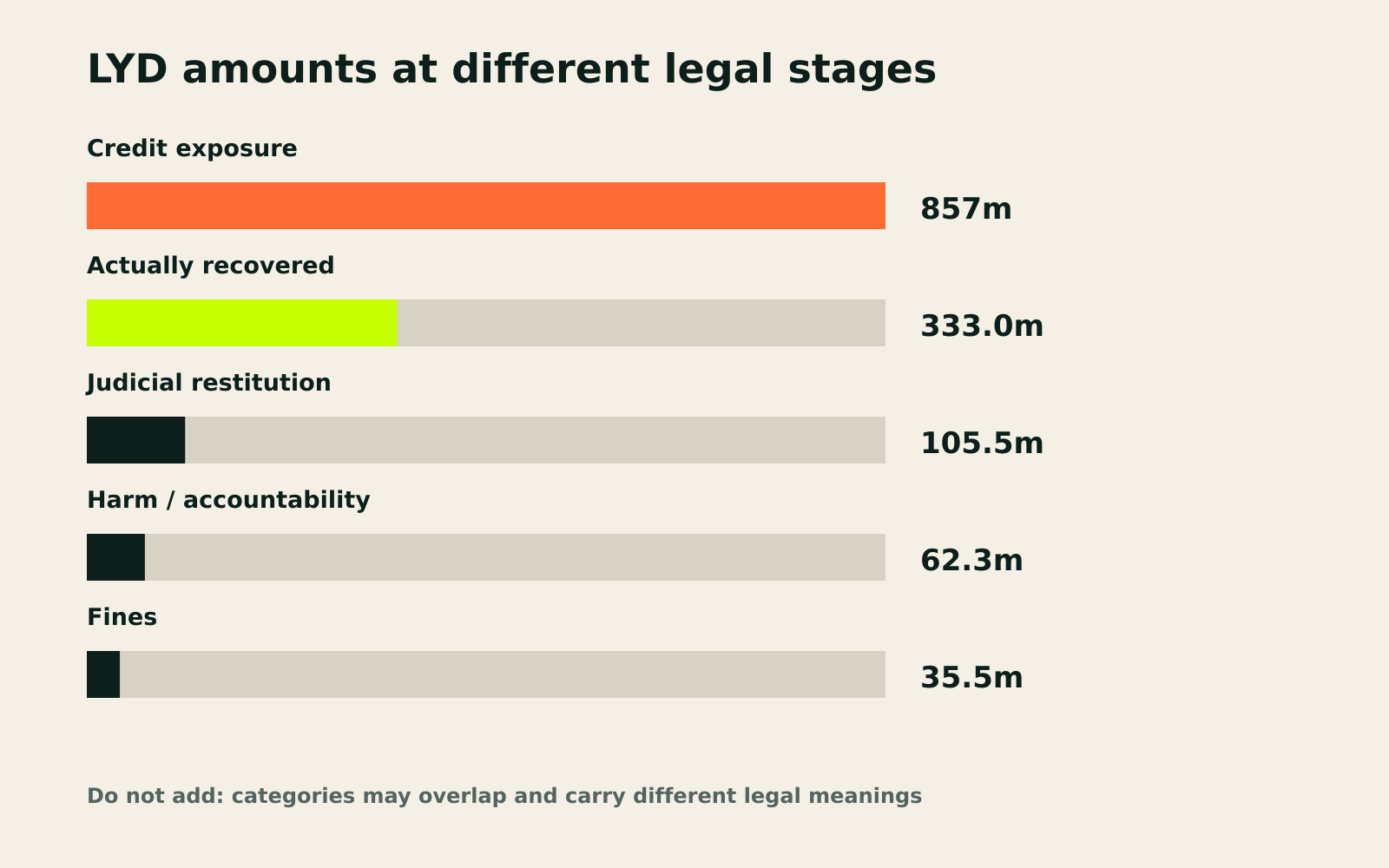
Dear reader, follow the money carefully. A fine is not a published loss. A court order to repay is not proof that the treasury received the money. Credit exposure is not necessarily a loss, and a contract value is not necessarily an amount paid. The currencies and legal categories below must therefore remain separate.
| Financial status | Unique entries | Libyan dinars | US dollars | Euros | What the publication establishes |
|---|---|---|---|---|---|
| Reported actual recovery | 4 | 333,014,600 | 5,700 | — | Described as returned |
| Judicial restitution orders | 8 | 105,499,679 | 579,000 | 286,575 | Ordered, but execution not fully disclosed |
| Fines | 17 | 35,461,000 | 1,825,986,090 | 573,150 | Penalties, not a measure of loss |
| Other financial amounts | 48 | Multiple categories | Multiple categories | Multiple categories | Exposure, contracts, alleged harm, bribes and benefits |
 Enlarge figure ↗
LYD 333 Million Reported as Actually Recovered
The publications explicitly described LYD 333,014,600 and $5,700 as recovered. The largest component—LYD 300 million—came from a Sahara Bank credit case and represented 90.1% of the recovered dinar total. A further LYD 33 million came from Agricultural Bank credit cases, while an identity-data case accounted for LYD 14,600 and $5,700.
At the Central Bank of Libya’s published selling rate of LYD 6.3492 to the dollar on 20 August 2026, the recovered dinar total was equivalent to about $52.45 million. The conversion is only a scale comparison; the legal record remains denominated in its original currencies.
The IMF’s 2025 Article IV projections ↗ put Libya’s 2026 nominal GDP at about LYD 254.2 billion. On that forecast, the recovered dinars equal roughly 0.13% of annual output. This does not measure recovery performance because the total amount legally recoverable across the reviewed cases was not published.
LYD 105.5 Million Ordered Repaid
Judicial restitution orders totalled LYD 105,499,679, plus $579,000 and €286,575. Banking cases accounted for LYD 88,019,679—or 83.4%—of the dinar orders. A telecommunications case added LYD 13.75 million and property and state-asset cases added LYD 3.73 million.
These are court-ordered repayments, not confirmed receipts. The publications did not provide a single execution ledger showing how much had been collected, when it was paid or what balance remained. One additional banking figure was excluded because the wording was too unstable to classify safely.
A $1.83 Billion Fine—Not a Published Loss
After deduplication, fines totalled $1,825,986,090, LYD 35,461,000 and €573,150. The exceptional dollar amount arose in a case involving a former international-marketing official and the failure to collect proceeds for oil and petroleum products between 2010 and 2017.
The Attorney General’s publication did not state the underlying principal that went uncollected. The fine must therefore not be presented as the value of the loss, and the publication did not say how much of it had been paid.
For scale only, $1.826 billion would equal about 29.3 million barrels at the IMF’s projected 2026 Libyan oil price of $62.4 per barrel—roughly 24 days of exports at the IMF’s projected 1.2 million barrels a day. It is also about 3.8% of the IMF’s projected 2026 nominal GDP of $47.7 billion and 6.3% of projected hydrocarbon exports of $29.1 billion.
The nominal figure is larger than the US Department of Justice’s more than $1.1 billion Glencore resolution ↗ in 2022 and is about 63% of the more than $2.9 billion Goldman Sachs resolution ↗ in 2020. These were different jurisdictions, offences and settlement structures; the comparison shows magnitude, not equivalence.
LYD 62.3 Million Under Loss or Accountability
Amounts described as alleged embezzlement, waste, improper spending, uncollected tax, unlawful benefit or mismanaged allocations reached LYD 62,306,450.
This basket included LYD 35,878,055 in waste, improper spending and uncollected tax; LYD 13.75 million in embezzlement established in the telecommunications judgment; LYD 8,912,395 across six banking-embezzlement cases; LYD 1.055 million in the Brega Hospital case; and LYD 2.711 million in unlawful benefit and mismanaged allocations.
It is not a final loss total. Cases were at different legal stages and some amounts remained allegations or investigative findings. A booked banking loss of €16 million was kept in its original currency. Documents worth $2.8 million were excluded from confirmed loss because their eventual collection status was not published.
 Enlarge figure ↗
LYD 857 Million Exposed, Not Necessarily Lost
The publications identified LYD 857 million in loans and credit granted without adequate guarantees: LYD 57 million for a hospital project and LYD 800 million in the Sahara Bank case.
The reported LYD 300 million recovery in the latter case equals 37.5% of the credit. But the difference of LYD 500 million cannot be labelled a loss. The publication said the authorities had prevented disposal of other traced funds without specifying how much had ultimately been collected.
Loans and financing worth €23 million may overlap with the recorded €16 million loss. An €11 million insulin-pump contract and a LYD 3.099 million medical-device contract were also disclosed. Contract values do not prove that the full amounts were paid or lost.
LYD 219,750 Paid to Open the Identity Gate
Explicit bribes and illegal consideration in eight national-number cases totalled LYD 209,150. Adding LYD 10,600 paid to buy a national number and identity data brings the disclosed illicit payments to LYD 219,750.
Forged citizenship documents were then used to obtain LYD 147,600 in grants and salaries and $150,000 in family foreign-currency allocations. Of these benefits, the publications explicitly reported recovering only LYD 14,600 and $5,700.
Dear reader, this is why the identity file belongs inside the money map. A falsified civil record was not merely an administrative document; it could become a gateway to salaries, grants, foreign currency, passports and public employment.
More Than Half the Cases Had No Financial Value
Sixty of the 113 estimated unique case tracks contained no measurable financial figure. The missing values included two ambulances that were sold, 14,000 litres of diesel, fuel linked to 36 distribution instruments, seized drugs and vehicles, and the principal of uncollected oil proceeds.
Also absent were the value of a contract granting a private party 75% of a public market’s revenue for six years, tuna-fishing quotas, ransoms, victim compensation and property damage in abduction and violence cases.
The gap is therefore not evidence that these cases were financially minor. It shows that the public record did not price them.
The International Recovery Gap
The FATF and INTERPOL ↗ reported in 2022 that countries intercept and recover less than 1% of global illicit financial flows. FATF’s 2025 asset-recovery guidance ↗ said more than 80% of assessed jurisdictions had low or moderate effectiveness in asset recovery.
In the European Union, organised-crime profits are estimated at about €139 billion a year, while roughly 2% is confiscated, according to the European Commission’s asset-recovery overview ↗.
These ratios cannot be calculated for the Libyan cases because the denominator—the total proceeds legally identified as recoverable—was not disclosed.
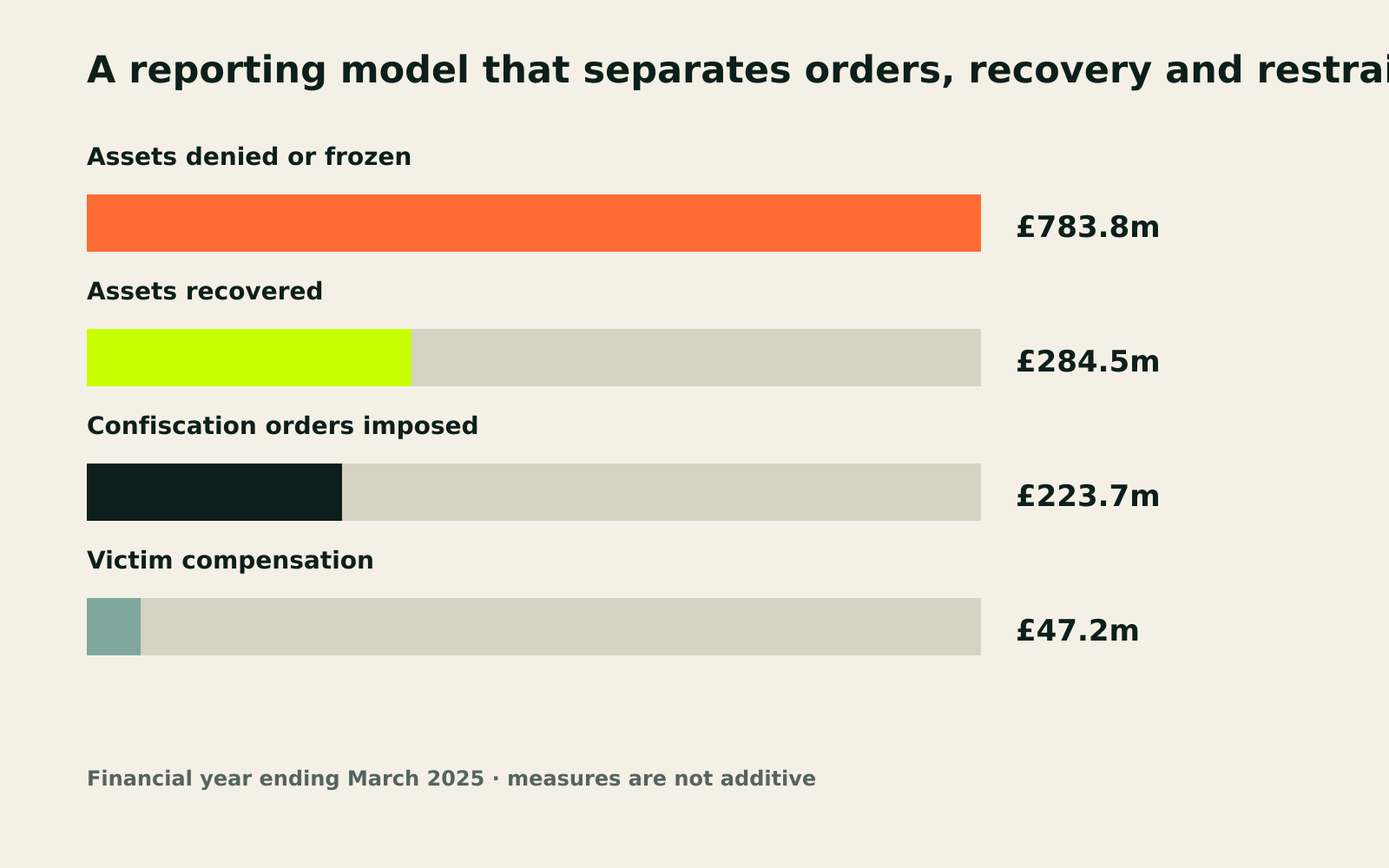
The United Kingdom offers a useful reporting model. For the financial year ending March 2025, it separately published £223.7 million in confiscation orders imposed, £284.5 million actually recovered, £783.8 million in assets denied or frozen, and £47.2 million paid as victim compensation. Recovery can exceed orders issued in the same year because it includes older orders and other mechanisms.
 Enlarge figure ↗
| Benchmark | Period | Published measure | Why it matters here |
|---|---|---|---|
| FATF / INTERPOL | 2022 | Less than 1% of global illicit financial flows intercepted and recovered | Shows the global enforcement gap |
| FATF effectiveness reviews | 2025 guidance | More than 80% of jurisdictions low or moderate | Measures outcomes, not legal powers alone |
| European Union | Current Commission overview | €139bn annual organised-crime profits; about 2% confiscated | Separates criminal proceeds from assets actually confiscated |
| United Kingdom | FY ending March 2025 | Orders, recoveries, restraint and compensation published separately | A reproducible public-ledger model |
What a Public Recovery Ledger Should Show
Libya does not need one grand total that mixes currencies and legal meanings. It needs a case-level ledger showing the amount allegedly harmed, amount frozen, amount ordered repaid, fine imposed, amount actually collected, date of collection, assets sold and compensation paid to victims.
Such a ledger would allow the public to distinguish a headline judgment from money that returned to the treasury—and would make later updates measurable without rewriting the legal history of each case.
What Remains Undisclosed
The public record still does not show how much of the published fines was collected, the outstanding balance on each restitution order, the full value of assets frozen or sold, or the compensation ultimately paid to victims and public entities.
Until those figures are reconciled case by case, the LYD 333 million reported as recovered is the clearest measure of money that actually returned. The much larger fine totals remain measures of judicial decisions—not proof of collection.