 Mohamed Algarj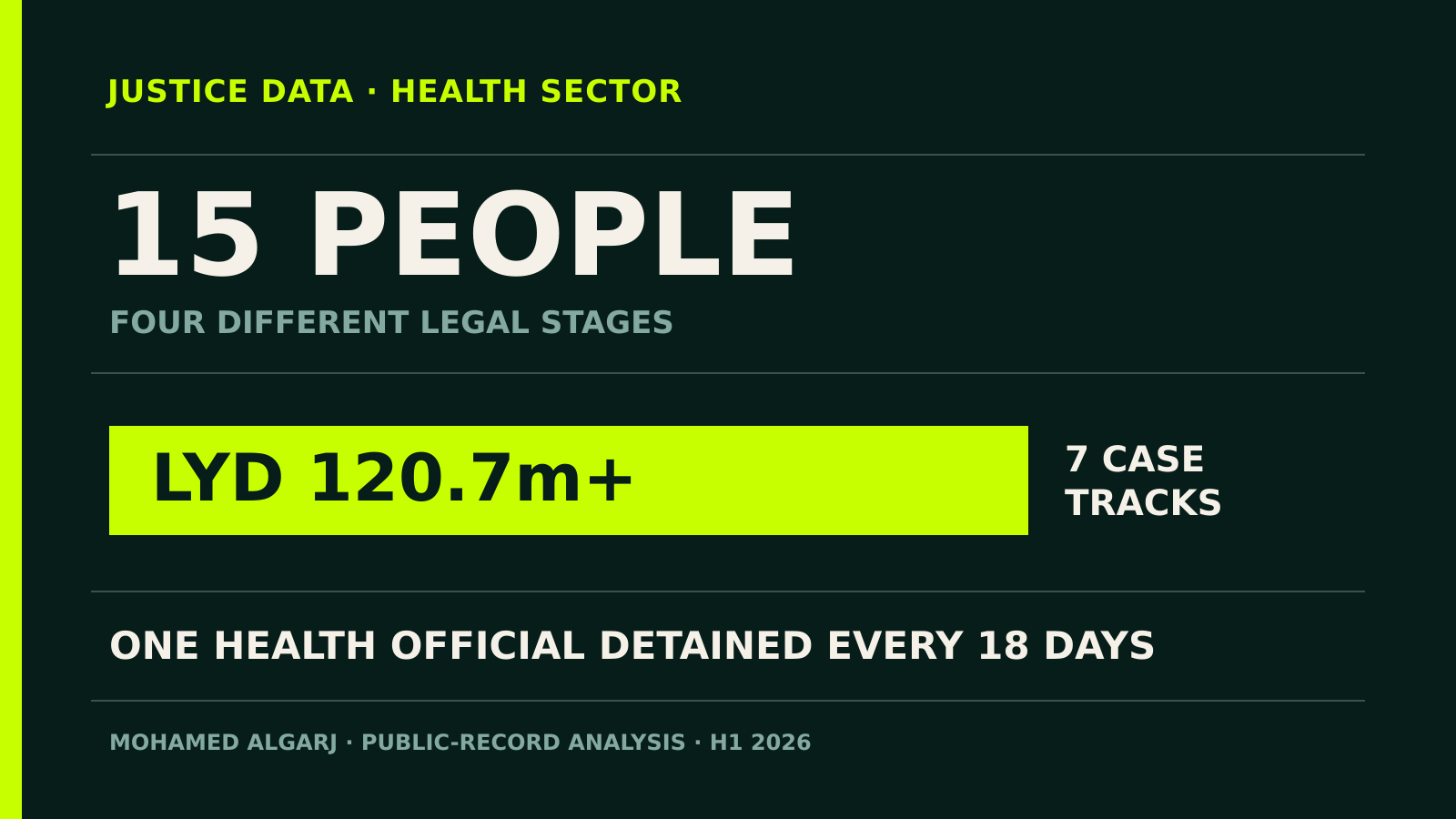
Seven health-sector case tracks appeared in releases published by the Libyan Attorney General’s Office during the first half of 2026. Together, the disclosed figures cover contracts, sums under investigation, court-ordered restitution and fines with an estimated value exceeding LYD 120.7 million — about $13.2 million at the publication-date reference rates used in this analysis.
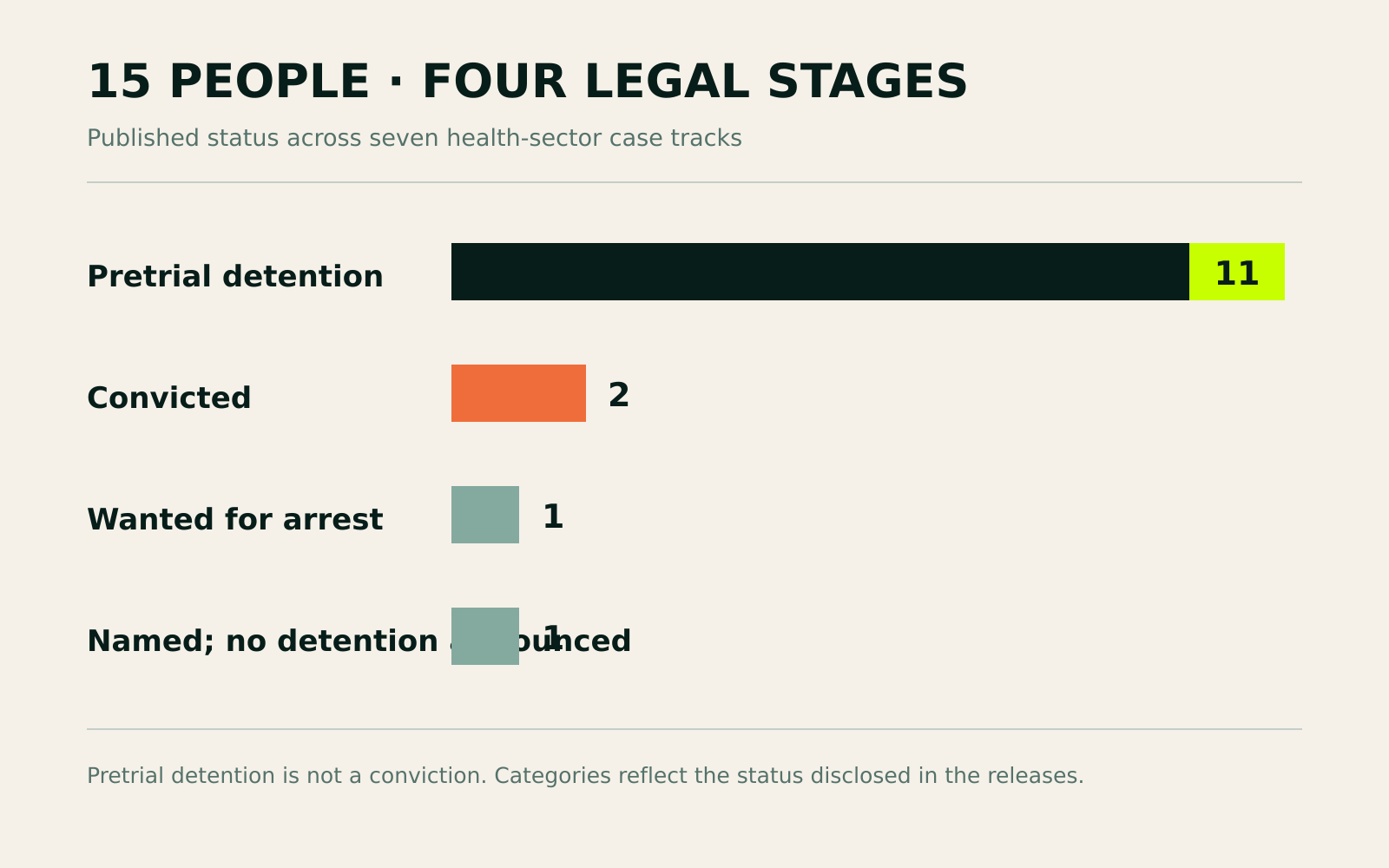
The cases involved 15 people at different legal stages: 11 in pretrial detention, two convicted, one wanted for arrest and one mentioned in an investigation without a published detention order.
| Indicator | Published total |
|---|---|
| Distinct health-sector case tracks | 7 |
| People appearing across the files | 15 |
| People in pretrial detention | 11 |
| People convicted | 2 |
| Wanted for arrest | 1 |
| Mentioned in an investigation, with no detention announced | 1 |
| Financial scope at the reference rates used | More than LYD 120.7m / about $13.2m |
Dear reader, the central issue is not simply the size of one contract or the number of arrests. It is what the published record reveals—and still does not reveal—about procurement controls, price testing and the recovery of health-sector money.
One Health Official Entered Pretrial Detention Every 18 Days
Ten of the 11 people placed in pretrial detention were officials or employees of public health entities. The eleventh represented a private supplier.
Across the 181 days in the first half of 2026, this works out to one public health official or employee entering pretrial detention approximately every 18.1 days.
 Enlarge figure ↗
This is a publication-rate calculation, not a measure of when the alleged conduct occurred. Pretrial detention is also not a conviction. It indicates that prosecutors considered detention necessary while an investigation continued; guilt can be established only through a final judicial process.
The case that reached judgment resulted in two convictions, both involving people outside the health entity that suffered the reported harm. The published record therefore contains two distinct groups that must not be conflated: people held while investigations continued and people convicted by a court.
More Than LYD 120.7 Million Across Contracts, Investigated Funds, Restitution and Fines
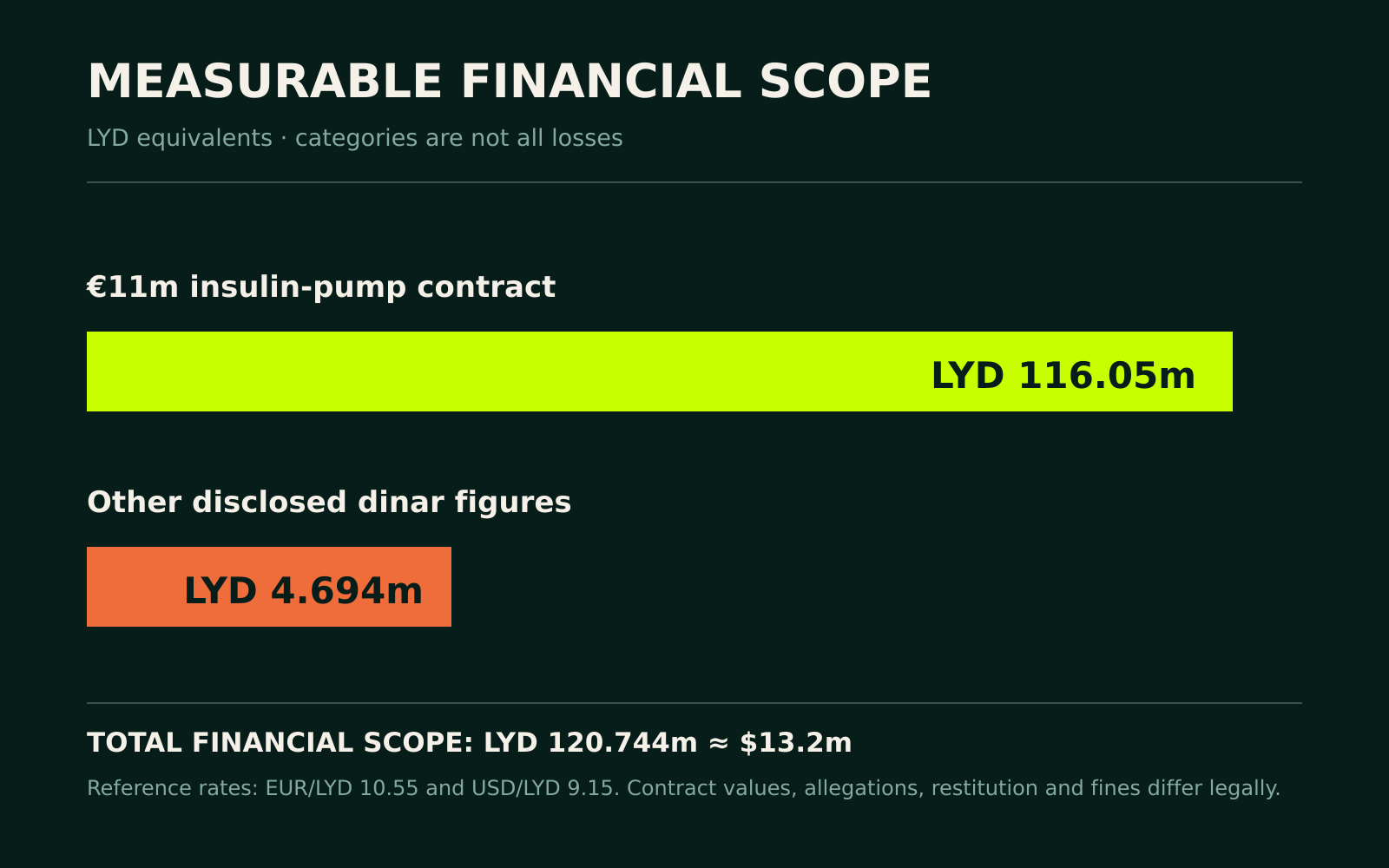
The largest disclosed figure was an €11 million contract for 1,000 insulin pumps—€11,000 per pump. Using the EUR/LYD reference rate of 10.55 applied in the original analysis, the contract is equivalent to approximately LYD 116.05 million.
The remaining disclosed dinar amounts totalled LYD 4.694 million. They included a LYD 3.099 million medical-equipment contract, LYD 340,000 described as the subject of an alleged embezzlement, and LYD 715,000 reportedly spent for a purpose other than the one for which it had been allocated. The published judgment also included LYD 180,000 in restitution and LYD 360,000 in fines.
| Published financial item | Original amount | Approximate LYD equivalent | Legal or analytical status |
|---|---|---|---|
| Contract for 1,000 insulin pumps | €11.000m | LYD 116.050m | Contract value under investigation |
| Medical-equipment contract | LYD 3.099m | LYD 3.099m | Contract value |
| Funds reportedly spent outside their allocated purpose | LYD 715,000 | LYD 715,000 | Investigative allegation |
| Alleged embezzlement | LYD 340,000 | LYD 340,000 | Investigative allegation |
| Court-ordered fines | LYD 360,000 | LYD 360,000 | Judicial order |
| Court-ordered restitution | LYD 180,000 | LYD 180,000 | Judicial order—not confirmed recovery |
 Enlarge figure ↗
These amounts describe different legal and accounting categories. The total is a measure of the financial scope appearing in the releases, not a statement that LYD 120.7 million was stolen, wasted or recovered. Contract values are not losses; allegations are not judgments; restitution orders and fines are not cash recovered unless execution is confirmed.
The record also omitted values for some medicines, assets, salaries and bonuses mentioned in the investigations. The measurable scope may therefore understate the money connected to the seven cases, even as it must not be mislabelled as a proven loss.
A Potential Pricing Gap of More Than €6.1 Million
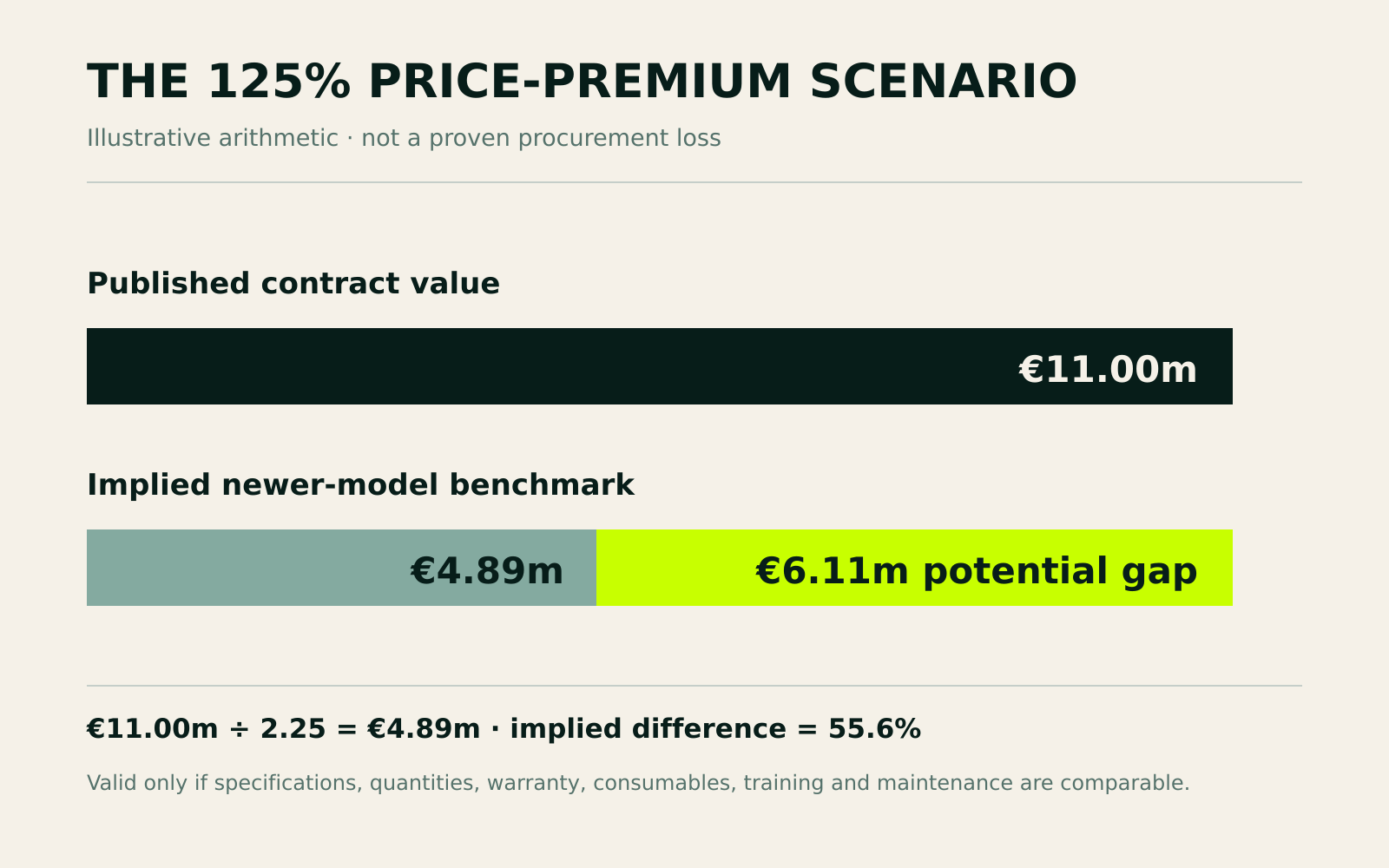
In the insulin-pump file, the investigation reported that the older model was priced approximately 125% above the newer model. If the comparison is applied uniformly to the full €11 million contract—and only if the specifications, quantities, warranties, consumables, training and maintenance are genuinely comparable—the arithmetic implies a newer-model benchmark of about €4.89 million and a potential gap of approximately €6.11 million.
 Enlarge figure ↗
The implied gap is 55.6% of the contract value. It is a scenario calculation, not a proven loss. A defensible procurement review would need the tender file, technical specifications, unit prices, bundled services, delivery records, acceptance certificates and competing bids before determining whether the price difference represents overpricing or a difference in what was purchased.
Why Health Procurement Deserves Its Own Transparency System
The health sector is not a marginal procurement category internationally. According to the OECD’s Government at a Glance 2025 ↗, public procurement equalled 12.7% of GDP and 29.9% of total government expenditure across OECD countries in 2023. Health was the largest function, accounting for 29.7% of procurement spending.
The same OECD review found that 17 of 35 surveyed countries—49%—used sector-specific central purchasing bodies for health procurement. Central purchasing is not an automatic cure, but it can make unit-price comparison, supplier due diligence, framework contracts and audit trails easier to standardise.
The World Health Organization ↗ cites an earlier estimate that 20% to 40% of health resources may be lost through different forms of inefficiency. That global range is not an estimate for Libya and must not be used to calculate a Libyan loss. It explains why price benchmarking, delivery verification and transparent purchasing data are essential parts of health policy rather than administrative detail.
The Missing Public Ledger
The Attorney General’s releases show enforcement activity, but they do not provide a single ledger connecting each contract to its tender method, bidders, beneficial owner, unit price, delivery date, acceptance certificate, payment status, frozen assets, final judgment and amount actually recovered.
That missing link prevents the public from answering the most important questions: Were the goods delivered and medically accepted? How much of the restitution and fines was collected? Were suppliers suspended or allowed to bid again? Did the investigations lead health authorities to change procurement controls?
Until those answers are published, the measurable record remains stark: seven case tracks, 15 people, more than LYD 120.7 million in financial scope, and ten health officials or employees placed in pretrial detention during half a year.
Source note: Libyan Attorney General’s Office releases for the first half of 2026. International context: OECD and World Health Organization. Currency equivalents use the publication-date reference rates applied in the analysis—EUR/LYD 10.55 and USD/LYD 9.15—and are comparisons, not transaction rates.